Essay
Other Ways of Knowing

“The most obvious, ubiquitous, important realities are often the ones that are hardest to see and talk about.” (David Foster Wallace)

Esotericism is all about knowledge.1 Its true concern is not with information or technical explanations but with the deeper quest for understanding what reality is all about. It shares this focus with other pursuits such as philosophy or science, while drawing inspiration from a large spectrum of established religious or spiritual traditions – but in marked contrast to these, it is typical for esoteric authors or practitioners to explore other ways of knowing than those that are currently dominant in Western culture and secular societies. This makes esotericism obviously controversial among our intellectual and educational elites, who insist on their own understandings of what true knowledge means. By the same token, it accounts for the current popularity of esoteric beliefs among all those who feel disappointed or are simply not convinced by what mainstream society tells them to accept as reliable knowledge. The result is a polarized public discourse in which vocal opponents of esotericism are pitted against its vocal defenders, each preaching to their own choir, at the expense of constructive exchange and serious critical dialogue about different ways of understanding and experiencing the world.
And yet it is dialogue that we need more than anything in our current world situation – whether the topic is esotericism or any other field of discussion concerned with human values, the nature of reality, the course of history, the world in which we live, or the meaning of our lives. Roughly since the financial crisis of 2009 and increasingly after the Covid-19 pandemic of 2020-2022, we are seeing extreme levels of political polarization and an unprecedented collapse of communication itself, so that it often seems we no longer share basic assumptions about what is true or false or how to find answers to vital questions. Simultaneously, with the rise of smartphones and commercial algorithms since the early 2010s, we all tend to withdraw into private media bubbles that systematically confirm what we already believe while insulating us from other perspectives. Last but not least, AI-driven inventions such as deepfake technology and other techniques for creating virtual realities have resulted in a post-truth society where alternative facts and fictional worlds become dominant to such a degree that it looks as though everything is possible because nothing is true.2
And here we get to the point. Under these extreme contemporary conditions, we risk losing our ability to draw meaningful distinctions between knowledge and mere opinion. We find we can no longer resolve our differences by having serious conversations in which we reach out to others, take the time to listen carefully to what they might be able to tell us, and try to learn from perspectives that might clash significantly with our own. If human dialogue breaks down, because our channels of communication are turning from bridges into barriers, we end up finding ourselves alone – with just one remaining option for resolving our differences, that of trying to impose our will on others by force while using any means at our disposal. If nothing is true, then not just does everything become possible but everything is permitted.3 We are currently seeing this logic at work in the world all around us.
But assuming that we need to cultivate dialogue and serious exchange about what we can know and what is real, why should esotericism be a topic of choice? The very suggestion might seem counter-intuitive to many, even absurd – given the state our world is in, don’t we have more important things to talk about? Here I’d like to call your attention to the opening quote from the American writer David Foster Wallace, in his luminous commencement speech This is Water delivered at Kenyon College in 2005. As he pointed out, “the really significant education in thinking that we’re supposed to get … isn’t really about the capacity to think, but rather about the choice of what to think about.”4
It is important to realize that, to a much larger extent than we normally realize, we allow our educational institutions to make most of those choices for us. And in a very similar manner, we allow our social and conventional media to tell us continually on a daily basis what to think about. As a result, we are missing a lot. Perhaps the most important “esoteric” secret that opens the gate to all others consists in a straightforward historical fact. Here it is:
The basic approaches to knowledge and reality that currently dominate our world, and to which we are exposed on a daily basis, all happen to be grounded in the systematic exclusion of any different or competing approaches in European culture over long stretches of time.5
The official standard narrative tells us that this exclusion happened for very good reasons: those “other ways of knowing” were actually little more than irrational nonsense, outdated superstitions, or even dangerous demonic delusions. By contrast, popular esoteric counter-narratives insist that it happened for an entirely different reason: because the religious and scientific establishment has always been hostile and blind to true spiritual knowledge or hidden mysteries and therefore tries to suppress them.
Yet if we decide to delve more deeply into the question of what is true and what is not, I suggest the first thing we should do is bracket such comfortable certainties and admit how little we actually know for certain and how much all of us have yet to learn. For let’s be honest – how well informed are we really about all those worldviews and traditions and other ways of knowing that fall under the “esotericism” umbrella? How sophisticated is our personal knowledge of their official counterparts, or of how specific esoteric ideas might either conflict or could possibly converge with more widely accepted perspectives? Isn’t it true that much of what we confidently claim to know actually rests on a more or less unquestioning acceptance of the authority of others, including their warnings not to take seriously what the other team is saying? How often in our lives do we take the time to actually talk and listen to people whose perspectives we assume we cannot share? In short, with reference again to David Foster Wallace: we might be perfectly capable of thinking – but to whom do we delegate our decisions about what to think about?
If we do choose to think about esotericism, for instance by watching and listening to MarcoToday, my initial advice is to cultivate an open attitude of radical agnosticism. Rather than assuming that we already know what is true and what is not, it is far more fruitful to be curious about what we do not yet know but might be able to learn. The pursuit of knowledge can never be separated from the pursuit of experience, for by definition we never learn anything except by having new experiences – whether they consist in reading a book, performing a technical scientific experiment or resolving a difficult calculation, talking with somebody who has different ideas, reading and interpreting sacred scriptures to discover their hidden meanings, trying out some spiritual technique or changing our consciousness, listening to great music or poems, or watching and listening to a podcast.6 If we do any such thing with an intention of learning something new about the nature of reality, without making any assumptions in advance about what might happen or what we might encounter, we are engaging in a practice that may be referred to as radical empiricism.
But assuming that we take this advice, then how and where should we draw the line? Surely the pursuit of knowledge does not just consist in limitless openness to any and all opinions. It requires a careful practice of discrimination in deciding which sources of information we choose to expose ourselves to and which ones we should better leave aside because they are misleading, superficial, or badly informed. It also requires a practice of discernment in evaluating conflicting or possibly incommensurable claims about reality and truth.7 The traditional term for such abilities or skills is wisdom – a term that tends to be used just a bit too easily by many esoteric practitioners, in their frequent references to “ancient wisdom,” whereas sceptics mostly tend to avoid it just a bit too easily too, in favour of “reason” or “critique.”
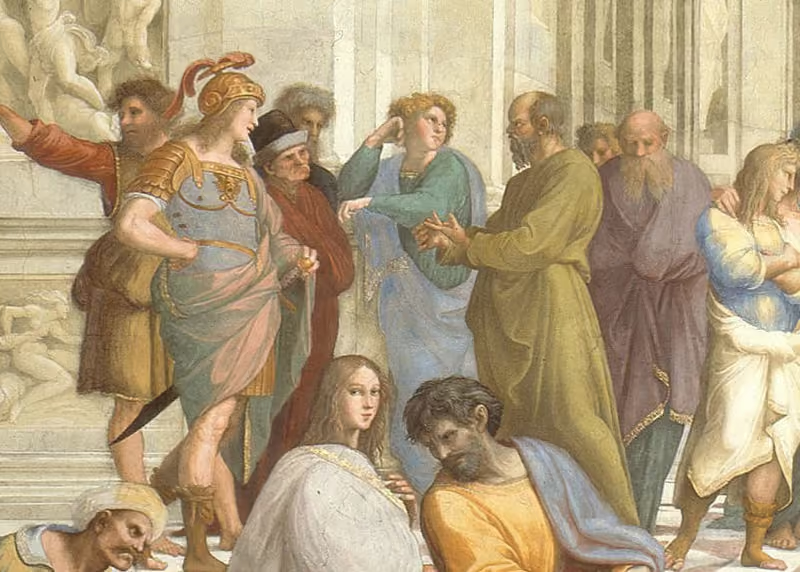
And yet wisdom is what we need in our current world situation. It so happens that the pursuit of wisdom lies at the very heart and historical origin of both philosophy (philosophia = love of wisdom) and esotericism – in the foundational intellectual and spiritual tradition that has come to be known as Platonism. Its ultimate concern was with the human question of “how should we live our lives?,” or formulated differently, “what is good for us and what is not?” These questions obviously remain as relevant today as they were thousands of years ago. Platonists insisted that to find answers, we need to combine two different things that later generations would come to see as separate and even as opposed to one another: sharp but generous conversations grounded in respect for the power of demonstrable evidence and rational arguments and some kind of immediate spiritual perception of “true reality” (alētheia, “the unconcealed”) beyond reason and the physical senses. In my opinion, Plato’s famous protagonist Socrates embodied everything we need: the spirit of human dialogue, the profoundly ambitious search for ultimate knowledge and (paradoxical as it might seem) a quite as profoundly modest attitude of radical agnosticism.8 Those who are confident about knowing the truth thereby merely demonstrate the extent of their ignorance. But those who know that they do not know have every reason to continue chasing that elusive goal of knowledge and wisdom in their lives.
——————————
1 This is not an essentialist statement about the true nature of esotericism “as such” but an observation about the ways in which scholars have been trying to define it. An influential early definition by the French pioneer Antoine Faivre suggests that the human faculty of imagination is an instrument for gaining knowledge of spiritual worlds. The German scholar Kocku von Stuckrad defined esoteric discourse in terms of the search for higher or absolute knowledge. Many scholars have emphasized the search for salvational gnōsis (immediate spiritual knowledge or insight) as central to esotericism. In my own work, I refer to esotericism as “rejected knowledge.” For general overviews and discussion of these different approaches, see Wouter J. Hanegraaff, Esotericism in Western Culture: Counter-Normativity and Rejected Knowledge, Bloomsbury: London 2025, chapter one.
2 The reference is to Peter Pomerantsev, Nothing is True and Everything is Possible: The Surreal Heart of the New Russia, Public Affairs: New York 2014.
3 The phrase “Nothing is true; everything is permitted,” popularized by the video game Assassin’s Creed, was taken from Vladimir Bartol’s 1938 novel Alamut about the Nizari Ismaili Muslims known as Hashshashins. With ultimate origins in the work of Silvestre de Sacy, the literal phrase occurred first in Gustav L. Flügel, Die Geschichte der Araber bis auf den Sturz des Chalifats von Bagdad, Brandes: Leipzig 1840, 251. Friedrich Nietzsche took up the idea in Genealogie der Moral: Ein Streitschrift, C.G. Naumann: Leipzig 1887.
4 David Foster Wallace, This Is Water: Some Thoughts, Delivered on a Significant Occasion, about Living a Compassionate Life, Little, Brown and Company: New York / Boston / London 2009, 14. Opening quote on p. 8. The original audio is available on YouTube.
5 Wouter J. Hanegraaff, Esotericism and the Academy: Rejected Knowledge in Western Culture, Cambridge University Press 2012; for a summary version see Hanegraaff, Esotericism in Western Culture, chapters 3 and 9.
6 For the argument that “everything is empirical,” see my lecture “Metaphysical Foundations of Radical Empiricism in the Study of Esotericism” (Conference Esotericism & Philosophy, University of Helsinki 12-13 June 2025), available on YouTube.
7 The concept of incommensurability was introduced into philosophy of science by Thomas Kuhn and Paul Feyerabend during the 1960s and means that certain claims of knowledge cannot be directly compared or measured against each other because they lack a common standard of comparison. A significant parallel in the study of esotericism is the argument, indebted to the psychologist Charles T. Tart, for “state-specific knowledge” (discussion in Wouter J. Hanegraaff, “Subtle Energies in Ayahuasca Healing,” in: Julian Strube, Marleen Thaler & Dominic Zöhrer, eds., Subtle Energies in Therapy, Spirituality, Arts & Politics: 1800-Present, Brill: Leiden / Boston 2026, 187-206).
8 Plato, Apology 21d.
Related

Subscribe to the MarcoToday newsletter
and join the conversation.